Sitbuster Join the beta

How it builds the habit

Small, often, and kind when life gets busy.

Sitbuster is a game, but it's built on what research says helps a habit last: keep the daily step small, tie it to moments that already happen, forgive the bad weeks, and grow gently.

Here are the four, each starting from a moment you may know, with the sources.

Small daily wins

Some days a full workout just isn't going to happen. On those days it's tempting to do nothing at all, and then tomorrow feels easier to skip too.

So Sitbuster keeps the daily step small. A day counts with one camera set, or a few different small wins with a move among them. The bar stays low on a packed day, and honest: the moves that keep your streak are checked by the camera, by your steps or by a timer.

Small wins fit a desk day: a walk after a meal, a one-minute move break, a few minutes outside, a drink, logging off on time. You pick the ones that suit you, and each shows how strong its evidence is.
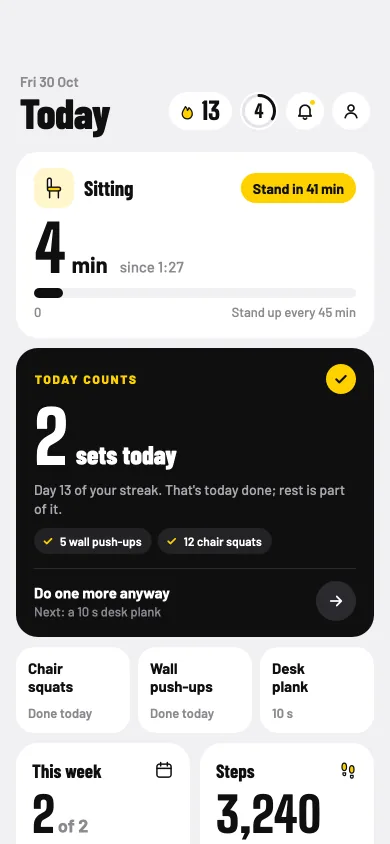
Today after the day has counted: a black card reading 2 sets today, day 13 of the streak.
Today counts. Two sets, and the day is done.
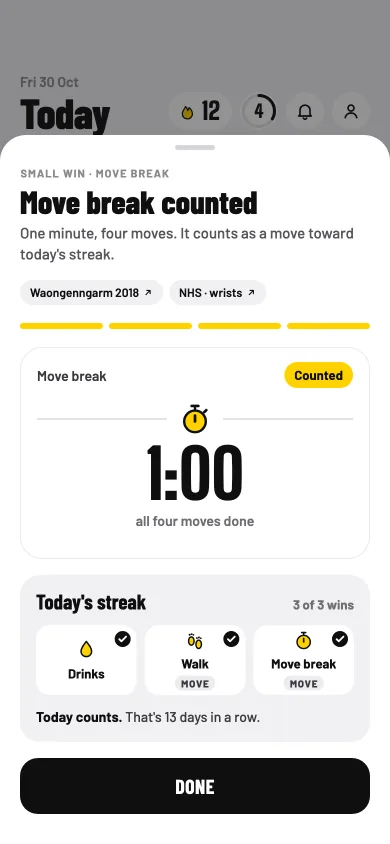
Move break counted: all four moves done in 1:00, and today's streak card at 3 of 3 wins: Today counts.
Or a few small wins. A minute's move break can be one of them.

Habits take time: across 20 studies, a new health habit took about two months on average, and some took far longer.

Missing a single day didn't harm forming a habit. Doing it consistently is what counted.

Keeping track of your own sitting cut it, but clearly only when it was measured objectively.

Streaks that forgive

You'd kept a streak going for three weeks in another app. Then a cold, two missed days, and it was back to zero. You didn't open that app again.

A streak keeps you coming back, so Sitbuster makes breaks hurt less. Pick your rest days, and a planned rest day counts. Freezes, earned as you level up, cover a day you miss on their own. Away pauses the streak for illness, travel, caring or anything else, with no reason asked. And after a break, there's a way to earn your days back.

There's no guilt in the words: the app says what you've kept, never what you'll lose. The streak reminder is off unless you turn it on, it never comes on a rest day or while you're Away, and there's never a "streak lost" alert.

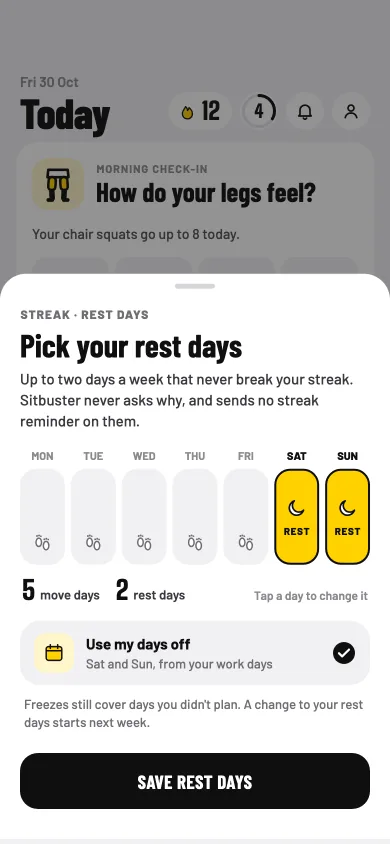
Pick your rest days: Saturday and Sunday marked REST, 5 move days and 2 rest days, and Use my days off.
Rest days count. Your days off keep your streak.
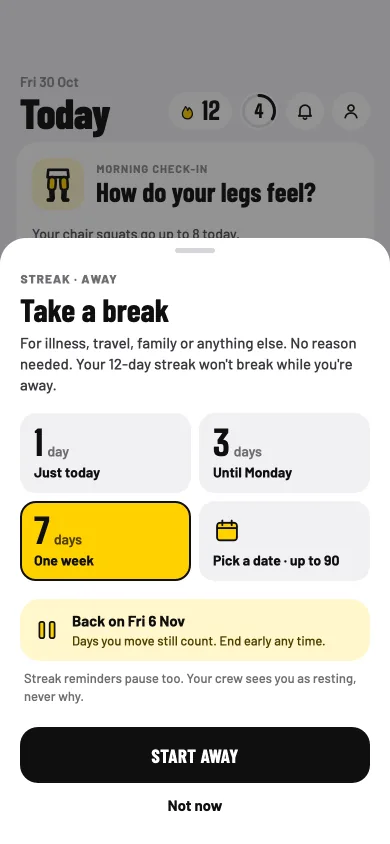
Take a break: for illness, travel, family or anything else, no reason needed. Choose 1 day, 3 days, 7 days or pick a date.
Away. For illness, travel, family or anything else.
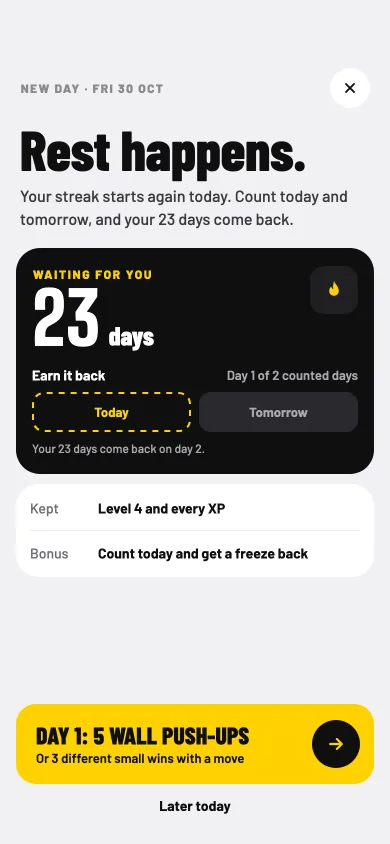
Rest happens: your 23 days are waiting, with a way to earn them back over today and tomorrow, and the next set.
Rest happens. Your days are waiting, with a way to earn them back.
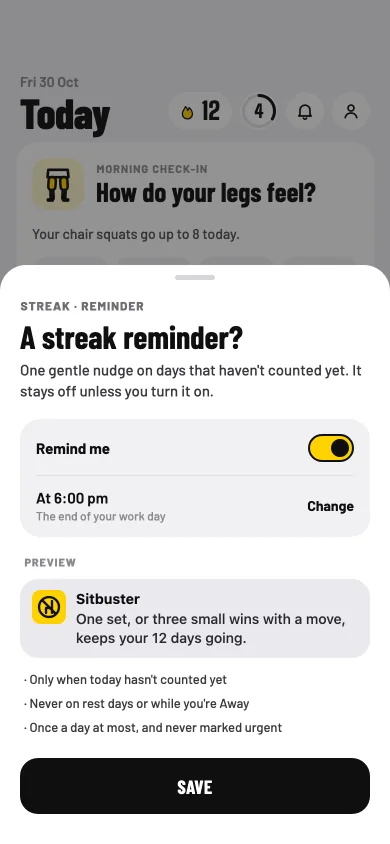
A streak reminder? One gentle nudge on days that haven't counted yet, off unless you turn it on, with a preview and its three rules.
An opt-in reminder. Off unless you turn it on.

In seven studies, people kept going more often when their record showed an unbroken streak, with exactly the same effort behind it.

Goals with a small spare reserve were preferred, and kept people going, because people tried not to use it.

In a megastudy of 54 gym programmes, the best one gave small rewards for coming back after a missed workout.

Messages about what you gain worked slightly better than messages about what you lose, for physical activity too.

Cues at the right moments

You fully mean to move more. But a good intention doesn't come with a time or a place, and the day fills up around it.

Sitbuster ties moving to moments that already happen in your day. It fits nudges around your meals and work hours: a walk after lunch and dinner, a stand-up when you've sat a while, log off at the end of the day. It holds a nudge while you're in a meeting, and stays quiet in your quiet hours.

Plans are concrete. Buddies pick one shared plan, like "After lunch, we both do our set." The weekly report ends with an if-then plan for the week ahead, and a quiet week gets a plan for busy days. And on Plus, your own nudges put any habit at a time you choose, like "Call Mom" every Sunday at 18:30.

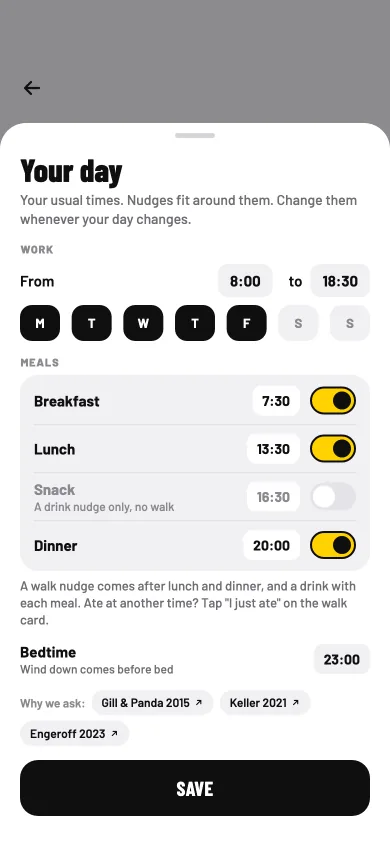
Your day: work from 8:00 to 18:30 on weekdays, breakfast, lunch and dinner times with switches, a snack switched off, and bedtime.
Your day. Work hours, meals and bedtime: the moments nudges fit around.
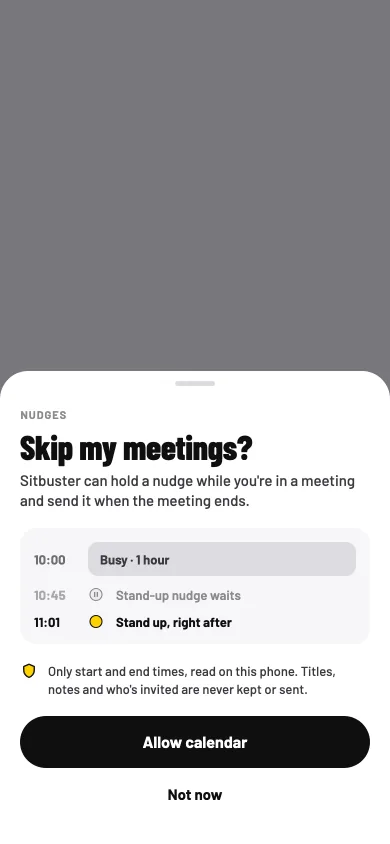
Skip my meetings? A timeline shows a stand-up waiting through a one-hour meeting and coming right after, with Allow calendar and Not now.
Quiet in meetings. A nudge waits, then comes right after.
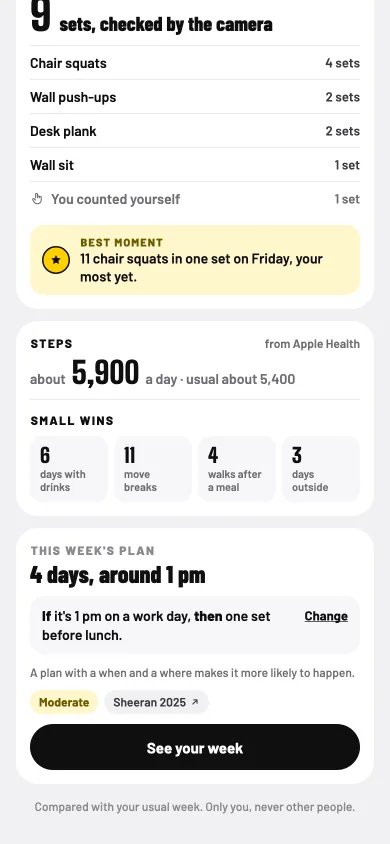
Lower in the weekly report: sets checked by the camera, the best moment, steps, small wins, and this week's plan: 4 days, around 1 pm, with an if-then line.
An if-then plan. "If it's 1 pm on a work day, then one set before lunch."
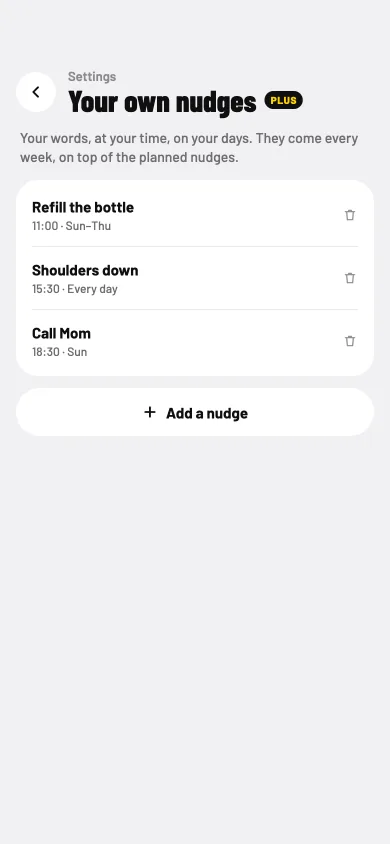
Your own nudges, a Plus setting: your words, at your time, on your days, every week. Refill the bottle at 11:00 Sunday to Thursday, Shoulders down at 15:30 every day, and Call Mom at 18:30 on Sunday.
Your own cues, on Plus. "Call Mom", every Sunday at 18:30.

Tying a new habit to a daily routine, or to a set time, helped it form equally well. Repeating the plan was what mattered most.

A plan with a when and a where makes it more likely to happen.

A plan for a busy day makes a slip less likely to end the habit.

Gentle progression

You've started too hard before: a big first week, sore legs, and a very quiet second week.

Everyone starts small. Your first sets are short, with a clear finish: "Stop here. That's today's win." Then your targets grow as you get stronger, with a reason you can read, never all at once.

The morning check-in asks how your muscles feel, and the plan listens: sore muscles rest, and pain pauses the moves that hurt. A harder rung is only ever offered; you choose. And on a quiet week, the report reminds you that any amount counts, and offers an easier week.

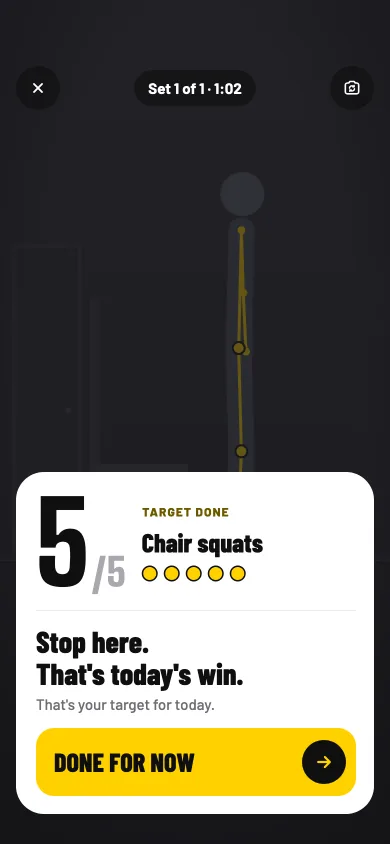
Target done: 5 of 5 chair squats. Stop here. That's today's win. That's your target for today.
Stop here. A clear finish, from the first day.
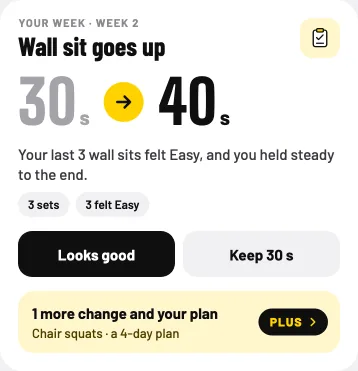
Your week on Today: Wall sit goes up from 30 to 40 seconds, because your last 3 wall sits felt Easy, with Looks good, Keep 30 s, and a Plus row for the next change and your plan.
A change, with its reason. Your targets grow as you get stronger, never all at once.
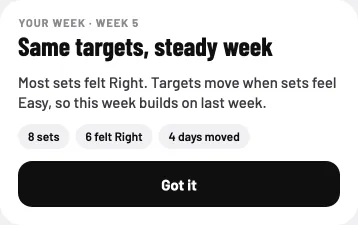
Same targets, steady week: most sets felt Right, so this week builds on last week, with 8 sets, 6 felt Right and 4 days moved.
Or a steady week. Not every week has to go up.

Some movement is better than none. Any amount counts.

WHO advises muscle-strengthening on 2 or more days a week, working all major muscle groups.

Built to be kind

No guilt. No countdowns.

Some apps keep you coming back with guilt and countdowns. Sitbuster doesn't.

  • No countdowns to losing a streak, and no red crosses for missed days.
  • Rest days and Away never ask why, and never show on share cards.
  • Nothing about health, rest, Away, pain or fasting on the lock screen or in notifications.
  • Streak protection is never sold.
  • Plus is never offered at a streak moment.